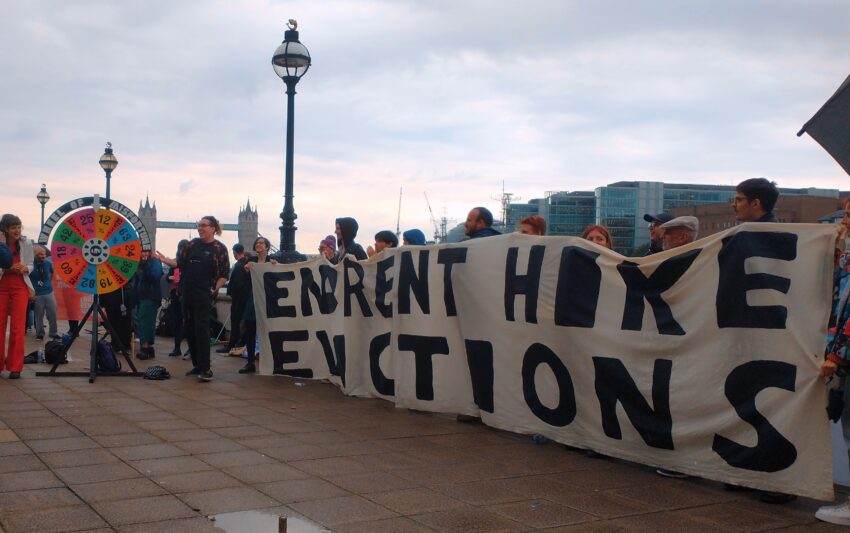
In the Global North, we live in difficult times for the left. The right and far right have taken control of many governments, often by first taking control of the media. The resources arrayed against the left are the spoils of what some are calling a new ‘gilded age’. The left has come to recognise that taking back the ground occupied by billionaires and oligarchs may be a long struggle. While electoral politics has a part to play, the largest part of the task is a long, slow rebuilding of a left grassroots, one that will look something like the long march of the labour movement from its nineteenth-century beginnings to power at Westminster. Like those labour organisers, we need to move from a minority movement to a majority one, constructing new institutions as we go, and developing new forms of conflict that build our power.
In steps the new wave of tenant unions, which, crucially for confronting growing fascism, construct a community of solidarity where people live, and offer an alternative organising locus in the face of the geographic dispersion of workers now that commuting and, more recently, working from home are so common. In our divided and atomised societies, beset by loneliness and paranoia, building solidarity among neighbours is as important a task as anyone can take on in this moment.
There are clear reasons why housing has become a key battlefield right now. The marketisation of land was an important feature of the rise of capitalism, along with the marketisation of labour. For most of capitalism’s history, the workplace has remained the primary site of exploitation. But decades of neoliberalism have introduced a twist: with the outsourcing of industry to Asia and the free movement of capital, countries of the Global North have become more attractive as places to extract rent than to extract profit on labour. This rentier capitalism, as Brett Christophers has called it, is not merely about land and property. It is a wider model in which fantastic profits can be made by occupying and monopolising key infrastructure, including online infrastructure. But the rent extracted from land remains a significant part of the model, as exemplified by the grimly amusing sight of a Labour government attempting to make housing more affordable by following the guidance of global landlord BlackRock.
It is now housing that most often impoverishes us in the Global North. For some of us, it impoverishes us even more than our lack of control of capital: your boss might be taking twenty per cent of the value of your labour as their cut, while your landlord might be taking fifty per cent of what is left. Meanwhile, our housing conditions are often poor, and housing insecurity haunts us, nibbling away at our mental health. This is not just a ‘housing crisis’, this is a perpetual state of housing injustice, a theft of our money and our peace of mind by rent-seekers who regard us as substitutable cash cows rather than real people worthy of a good life.
Much of the left recognises that housing has become an intensified site of exploitation and sees the importance of the new wave of tenant organising as the militant response. Any time an article is written calling for new and radical grassroots movements to oppose the rise of the right, tenant unions will get a call-out. In Britain, they are sometimes mentioned as a key aspect of the organising that must feed into Your Party. Every left-wing media outlet periodically reports on a rent strike or a particularly inspiring tenant union campaign. Tenant unions are held out as a symbol of hope that there are always new or renewed forms of organising. As the author of a recent book (Renters Unite) about the new wave of radical tenant unions, I am always pleased to see this agreement on the importance of tenant organising. When I helped get the London Renters Union off the ground six years ago, I, along with many other organisers, understood that housing was becoming a defining organising site of the twenty-first century.
Setting up a tenant union was complicated, hard work, and exhilarating. We had never set up a tenant union before (who in London had!?) so we were making it up as we went along. We made mistakes, such as in clunky democratic processes, and had to correct them. We experimented with slogans – ‘There’s no such thing as a good landlord!’ – and discovered that a snappy slogan isn’t snappy if it needs explaining. We learned a lot about the grim reality of housing in London as we got to know people different to ourselves. We learned which tenants most wanted to organise and ended up doing more with housing association and temporary accommodation tenants than we had anticipated. We learned together how to win disputes as quickly as possible but also as collectively as possible. And the victories over landlords mounted up. Committing to organising in a tenant union is a life-transforming experience. It means understanding all the problems of an unequal, unjust society in a much more visceral way, but also understanding the collective joy in solidarity that can emerge from fighting it.
But outside the membership, the noise around tenant unions sometimes seems to outstrip the activity. Let’s compare them to the labour organising of yesteryear: whereas every city and town in the past would have had a trade union presence, many towns and cities across the Global North still have no tenant union presence. Membership in the tenant unions that exist, meanwhile, largely hovers around the thousands, even in big cities, rather than the tens or hundreds of thousands that we would have seen in the labour movement. Organising is not just a numbers game, but if we are to take tenant unionism seriously as a route to power for ordinary people, it does need to be widespread and normalised. It can’t just be a niche activity that occasionally attracts the attention of a council or legislators. If the tenant union movement is to live up to its potential, it must increase both in extent and in density across the towns and cities of the Global North.
The new wave of tenant organising is still a fairly young movement. After all, the labour movement sometimes took fifty or a hundred years to reach its peak. But it is no use for leftists to reference tenant unions as exciting and then not add themselves to the numbers of members. Even if we are in a workplace union or another organisation, we can still be in a tenant union. We surely need a tenant movement with exponentially more power than it currently has, and that means that we can’t leave it to others, any more than we can leave workplace organising to others.
Creating unions for all tenants isn’t easy. Ideological tensions can arise within tenant unions as soon as they become big enough to include people who don’t identify as radical anti-capitalists. We want to keep our unions radical, but we also need to ensure there is no great division established between union leadership (radical) and union base (politically mixed). If we want to prevent divisions arising, we certainly don’t want to be secretive about our politics. Yet in ensuring a certain level of unity within our organisations, we also don’t want to fall into moderate housing politics – or allow leadership to become moderate, as often happened in workplace unions. These are some fine lines to walk if we are to achieve real tenant union growth. Yet it is important to remember that the labour movement walked this line before us. It is merely a difficult balancing act, not impossible. It has been a pleasure to observe in the London Renters Union how some members recruited through housing disputes with ‘non-political’ views on housing have gradually understood how housing is necessarily political. Some of these members have migrated to central positions in the union and this journey is important.
It is also not the only path that members might take. Some potential and existing members of LRU are puzzled by issues that baffle their ‘common sense’: why isn’t the union interested in increasing home ownership? Why doesn’t the union spend more time befriending politicians and those in high places? Why would the union go on a march for Palestine? It’s okay for newcomers to feel unsure on these questions; it isn’t okay if they feel left out as time goes on. London Renters Union has done well at creating a general atmosphere where radical political ideas are mentioned frequently without pushing them on new members too hard. In more formal trainings the capitalist roots of the housing crisis are always explored, but members are free to just get on with practical organising if they wish.
This is all part of tenant unions feeling their way towards greater numbers, and many unions could give more thought to how to onboard the majority of tenants who don’t identify as particularly radical. That doesn’t always mean trying to ‘convert’ them into leftists. A few will respond to that, but just as many or more will walk away because they dislike being told that their more immediate visions of better housing aren’t radical enough. The organising itself has to be the core of a tenant union, not the ideas that give rise to the organising.
Indeed, my interviews with members of London Renters Union suggested that the idea that every tenant can be turned into an anti-capitalist campaigner can be unhelpful. Some union members just go along with ‘the radical stuff’ for a quiet life. And I realised that was fine. The labour movement likewise never turned every member into a radical anti-capitalist. I don’t believe this was what led to the moderation and weakening of the labour movement, which – often-compromised leadership aside – largely fell to direct, frontal attacks from the ruling class. Organising in your workplace was normalised even if you weren’t an anti-capitalist socialist. We need to do the same in tenant union organising.
A further lesson can also be taken from workplace organising: not every member we recruit to a tenant union will become a highly involved activist or organiser. We always want more capacity in our organisations, so it is easy to pressure members to do more and more as soon as they join. But people are living difficult lives, and sometimes we must accept that all we will get from them is their dues and perhaps turning up to an eviction resistance once a year. This should not be regarded as a problem, for if we pressurise everyone to become highly involved, many just back away and disappear out of guilt. If we want big numbers, we shouldn’t see less-involved members as failures, and we shouldn’t try to turn them into organisers unless they want that. Such balancing acts are an intrinsic part of the task ahead of us.
We can also spread tenant unionism by building alliances. For instance, a large pool of renters could be reached if the large trade unions agreed to send out calls for members to also join tenant unions. While most tenant unions don’t wish to be formally affiliated with a political party, that needn’t stop Your Party or the Green Party from becoming recruiting grounds, with members of the parties lobbying from within for the importance of joining tenant unions. There is also scope to increase engagement through digital methods even if face-to-face organising is the ideal: working with left wing social media figures to increase awareness of tenant unions, or providing more self-help webforms on tenant union websites to guide members through common disputes. Recruitment and engagement methods that don’t create more committed members immediately can still help build the financial and institutional strength of the unions.
Tenant unions are a key part of the puzzle for left-wing organising in the coming years, alongside labour organising, climate organising and community self-defence and mutual aid. But tenant unions will only become powerful enough to transform housing systems if we build them big and build them everywhere. If we are to really take on the power of landed interests, everyone we know and all of our neighbours need to be in tenant unions. It’s time to think big in tenant organising, and that means normalising tenant unions amongst both ourselves and the wider pool of renters.